A robocall or telemarketing call breaks federal law when it uses a recorded or AI voice without the consent the TCPA requires, calls a Do Not Call number repeatedly, ignores a stop request, or, for debt collectors, crosses the FDCPA’s harassment limits. The TCPA allows $500 to $1,500 per call. The FDCPA allows actual damages plus up to $1,000.
Start with the kind of call you are getting
The law that protects you depends less on how annoying the calls are and more on who is calling and how. This table sorts the common situations. Each has its own guide.
| Type of call | Main law | What usually decides the case |
|---|---|---|
| Debt collectors and creditors | TCPA for robocalls; FDCPA and Regulation F for third-party collectors | Recorded voice after you revoked consent; more than 7 calls in 7 days about one debt |
| Telemarketers and call centers | TCPA Do Not Call rules; Telemarketing Sales Rule | Registry status, number of calls in 12 months, who the seller is |
| Scam-style robocalls (cardholder services, auto warranty, free cruise) | TCPA prerecorded voice rules; Truth in Caller ID Act | Whether a real company can be tied to the call |
| Insurance, Medicare, solar and loan offers | TCPA; TSR; industry rules such as CMS limits on plan cold calls | Written consent, lead-generator forms, Do Not Call status |
| Calls meant for someone else | TCPA | The current subscriber’s consent, not the old owner’s |
| Spam texts and ringless voicemail | TCPA; state laws such as Florida’s FTSA | Which section applies and which federal circuit you live in |
| Personal harassment | Criminal law, 47 U.S.C. 223, and state law | Police and protective orders, not damages |
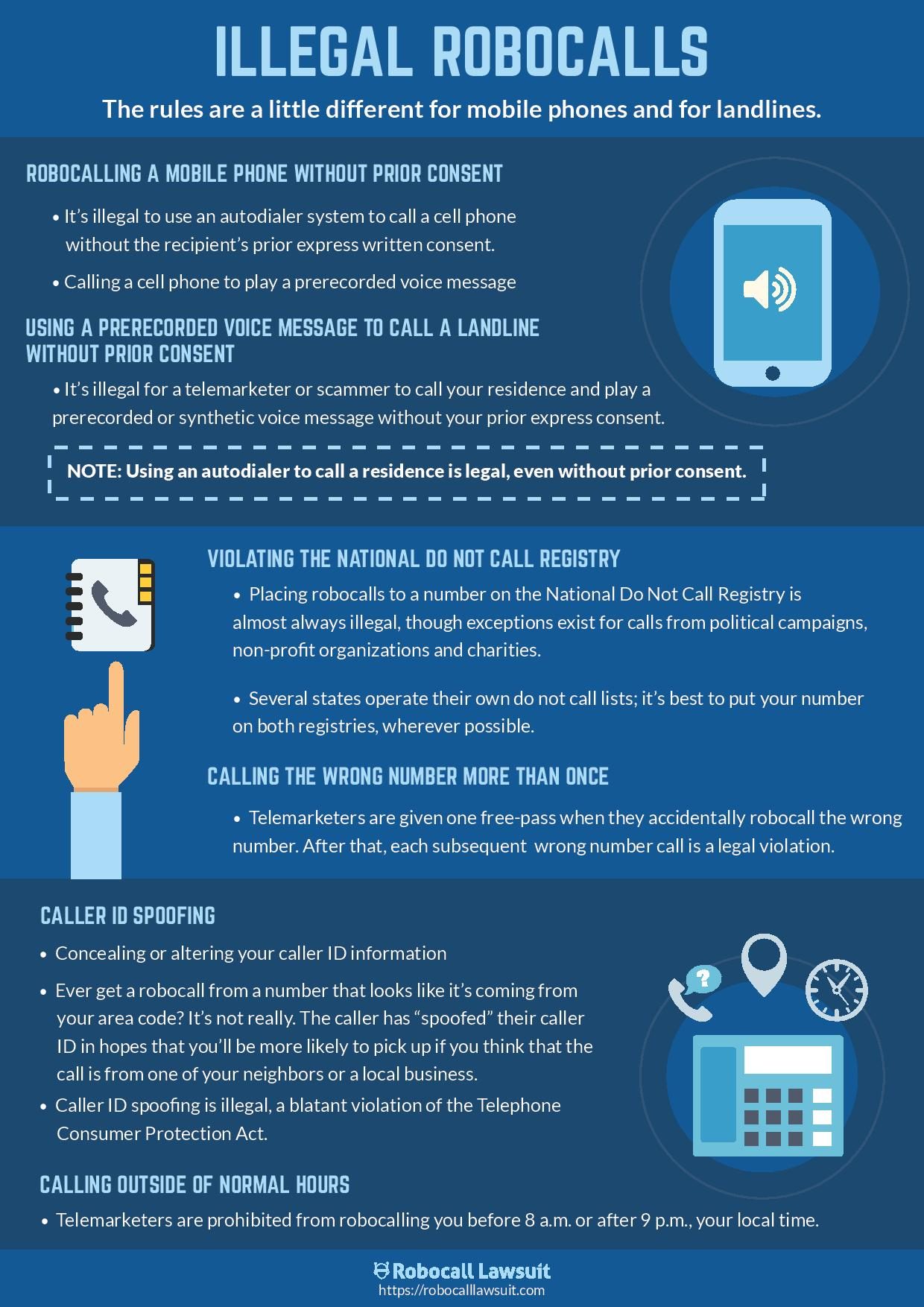
The four rules behind most robocall claims
Almost every successful consumer claim traces back to one of these federal rules:
- The recorded voice rule. Calls to a cell phone using an autodialer or an artificial or prerecorded voice need the called party’s prior express consent (47 U.S.C. 227(b)(1)(A)(iii)). If the call is telemarketing, the FCC requires prior express written consent (47 C.F.R. 64.1200(a)(2)). The FCC confirmed in 2024 that AI-generated voices count as artificial voices. See our guide to prerecorded and AI voice calls.
- The Do Not Call rule. A person on the National Do Not Call Registry who receives more than one sales call in 12 months from or for the same company can sue (227(c)(5)). Live calls count too.
- The stop rule. Companies must honor a do-not-call request within ten business days (64.1200(d)(3)), and must honor a revocation of consent to robocalls within the same period (64.1200(a)(10)).
- The collector rules. Third-party debt collectors are presumed to harass you if they call about one debt more than seven times in seven days, or within seven days after a phone conversation (12 C.F.R. 1006.14(b)(2)).
What each law can pay
| Law | Damages | Filing deadline |
|---|---|---|
| TCPA, 47 U.S.C. 227(b)(3) and (c)(5) | $500 per violation, up to $1,500 if willful or knowing | 4 years (federal catch-all, 28 U.S.C. 1658(a)) |
| FDCPA, 15 U.S.C. 1692k | Actual damages, up to $1,000 statutory per case, attorney’s fees | 1 year |
| Telemarketing Act, 15 U.S.C. 6104 | Private suits only if actual damages exceed $50,000 per person | 3 years after discovery |
| State mini-TCPAs | Varies by state | Varies |
The per-call structure of the TCPA is why repeated calls matter. Twenty illegal robocalls can mean $10,000 to $30,000 in statutory damages, if a real defendant is identified and the facts hold up. The TCPA case value calculator runs the numbers for your call count.
How regulators punish violators
Government enforcement does not pay you directly, but it shows how seriously these calls are treated, and the orders are public records you can point to.
- Auto warranty robocalls: on August 3, 2023, the FCC issued a $299,997,000 forfeiture against an operation that made more than five billion robocalls in three months of 2021.
- Health insurance robocalls: on March 17, 2021, the FCC fined the Rising Eagle telemarketers $225 million for about 1 billion calls, many spoofed.
- Telemarketing through agents: in United States v. DISH Network, a court found more than 65 million telemarketing violations and imposed $280 million; the Seventh Circuit upheld the core liability findings in 2020.
- “Rachel from Cardholder Services”: the FTC sued the operators in 2012 and obtained telemarketing bans and judgments.
How consumers enforce the law
You do not need a regulator to act. The TCPA gives you a private right to sue, either on your own or as part of a class. Individual cases make sense when you have many calls from one company and good records. Class actions make sense when a company called thousands of people the same way. In Krakauer v. Dish Network, a class of Do Not Call Registry members won a judgment of $61,243,800 over calls made by a Dish vendor, and the Fourth Circuit affirmed it in 2019.
When you probably do not have a case
Being honest about this saves you time:
- One call. The Do Not Call claim needs more than one call in 12 months from or for the same company.
- Calls you agreed to. If you gave a company your number for a loan or account, calls about that account are usually allowed until you revoke consent.
- No identifiable company. A pure scam operation with spoofed numbers may be impossible to sue. Keep records anyway; the seller sometimes surfaces later.
- Old calls. TCPA claims generally must be filed within four years, FDCPA claims within one.
- Live, non-sales calls. A person calling by hand about an existing account, without a recording, is usually outside the TCPA.
What your phone’s spam label adds
Labels like Scam Likely or Potential Spam come from carriers and analytics companies. They are predictions, not legal findings, but they can help you spot a pattern worth logging. Our guide to what spam labels on your phone mean explains who sets them and what they do and do not prove.
What to do next
Pick the guide that matches your calls, then start a record today: dates, times, numbers, voicemails and any company name. Our evidence call log is built for that. If you cannot tell who is calling yet, follow the steps in building a case against an unknown caller. When you have a company name and a pattern of calls, ask for a free case review, or read how to sue a telemarketer if you want to understand the process first.
Every violation type we cover
- Auto Warranty Robocalls: What the FCC’s Record Fine Tells You
Auto warranty robocalls sell service contracts, not warranties. See the FCC's $299,997,000 fine, why the calls are illegal and how to build a TCPA claim.
- Call Center Robocalls: Who Pays When a Vendor Makes the Calls
Call center robocalls often come from vendors hired by a bigger brand. Learn when the company that hired the call center is liable under the TCPA.
- Cardholder Services Calls: Why “Rachel” Is Not Your Bank
Cardholder services calls from "Rachel" pitch lower credit card rates. See what the FTC found, why the calls are illegal, and when you can sue for them.
- Debt Collector Robocalls: When Collection Calls Break the TCPA
Debt collector robocalls can break the TCPA when they use a recorded voice or autodialer without consent. Learn how consent works and how to revoke it.
- Free Cruise Robocalls: The Survey Calls That Led to a $76 Million Settlement
Free cruise robocalls offer a trip for taking a survey. See the $76 million Caribbean Cruise Line settlement, the FCC's $120 million fine and your options.
- Health Insurance Robocalls: Lead Generators, Fake Plans and Your Rights
Health insurance robocalls push ACA and short-term plans through lead generators. See the FCC and FTC actions, when calls are illegal and how to sue.
- Loan Offer Robocalls: Student Loan, Debt Relief and Personal Loan Calls
Loan offer robocalls pitch student loan forgiveness, debt relief and personal loans. See the FCC and FTC actions, the advance fee ban and when you can sue.
- Medicare Robocalls: The Rules Plans and Agents Must Follow
Medicare robocalls pitching Advantage plans or new benefits often break federal rules. See what Medicare and CMS allow and when you can sue under the TCPA.
- Phone Harassment Laws: Which Law Fits the Calls You Are Getting
Phone harassment laws depend on who is calling. Learn when harassing calls are a crime, an FDCPA claim or a TCPA claim, and which one pays damages.
- Ringless Voicemail: Why a Message Without a Ring Is Still a Robocall
Ringless voicemail laws treat voicemail drops as robocalls. See the FCC's 2022 ruling, when a ringless voicemail breaks the TCPA and what it can be worth.
- Solar Robocalls: When Solar Sales Calls Cross the Line
Solar robocalls and sales calls have led to TCPA settlements against SolarCity and Sunrun. Learn when solar calls are illegal and how to build a claim.
- Spam Text Lawsuit: Can You Sue for Spam Texts in 2026
A spam text lawsuit can pay $500 to $1,500 per text under the TCPA, but 2026 changed the rules. See which claims still work and what lawyers need.
- Telemarketer Violations: The Rules Sales Callers Must Follow
Telemarketer violations include calling Do Not Call numbers, using recordings without written consent and ignoring stop requests. See rules and damages.
- Wrong Number Robocalls: Your Rights When Calls Are for Someone Else
Wrong number robocalls meant for a past owner of your number can violate the TCPA. Learn how reassigned numbers, the FCC database and safe harbor work.
Frequently asked questions
What counts as a TCPA violation?
Common violations include robocalls or prerecorded messages to a cell phone without consent, more than one sales call in 12 months to a number on the Do Not Call Registry, calls after you asked the company to stop, and sales calls before 8 a.m. or after 9 p.m.
How much can I get for a robocall violation?
The TCPA sets $500 per violation, and a court can raise it to up to $1,500 if the violation was willful or knowing. FDCPA claims against debt collectors allow actual damages plus up to $1,000 and attorney’s fees.
Is it worth suing for robocalls?
It can be when you have repeated calls from an identifiable company and good records. One call, calls you consented to, or calls from untraceable scammers are usually not worth a lawsuit.
How long do I have to sue for robocalls?
Courts apply a four-year deadline to TCPA claims. FDCPA claims against debt collectors must be filed within one year of the violation.
Sources
- 47 U.S.C. 227 (Cornell LII)
- 47 C.F.R. 64.1200 (Cornell LII)
- 12 C.F.R. 1006.14 (Cornell LII)
- 15 U.S.C. 1692k (Cornell LII)
- 15 U.S.C. 6104 (Cornell LII)
- FCC news release (Aug. 3, 2023): Record penalty against auto warranty robocall operation
- FCC news release (Mar. 17, 2021): $225 million fine for spoofed health insurance robocalls
- United States v. DISH Network L.L.C. (7th Cir. 2020), CourtListener
- Krakauer v. Dish Network, L.L.C. (4th Cir. 2019)
- FTC press release (Nov. 1, 2012): Cardholder services robocall cases