Telephone Consumer Protection Act
Robocall Lawsuit: Find Out If Your Calls Are Worth $500 to $1,500 Each
Each illegal robocall or spam text can be worth $500 to $1,500 under the Telephone Consumer Protection Act. If a company called your cell with a recorded or AI voice, or kept calling a number on the Do Not Call Registry, you may have a case. Find out in a free, no-obligation case review.
- $500 to $1,500per illegal call or text
- 4 yearsto file under federal law
- $0upfront: contingency fee

Laurence Banville, Esq.
Managing Partner, Banville Law · NY and DC bars
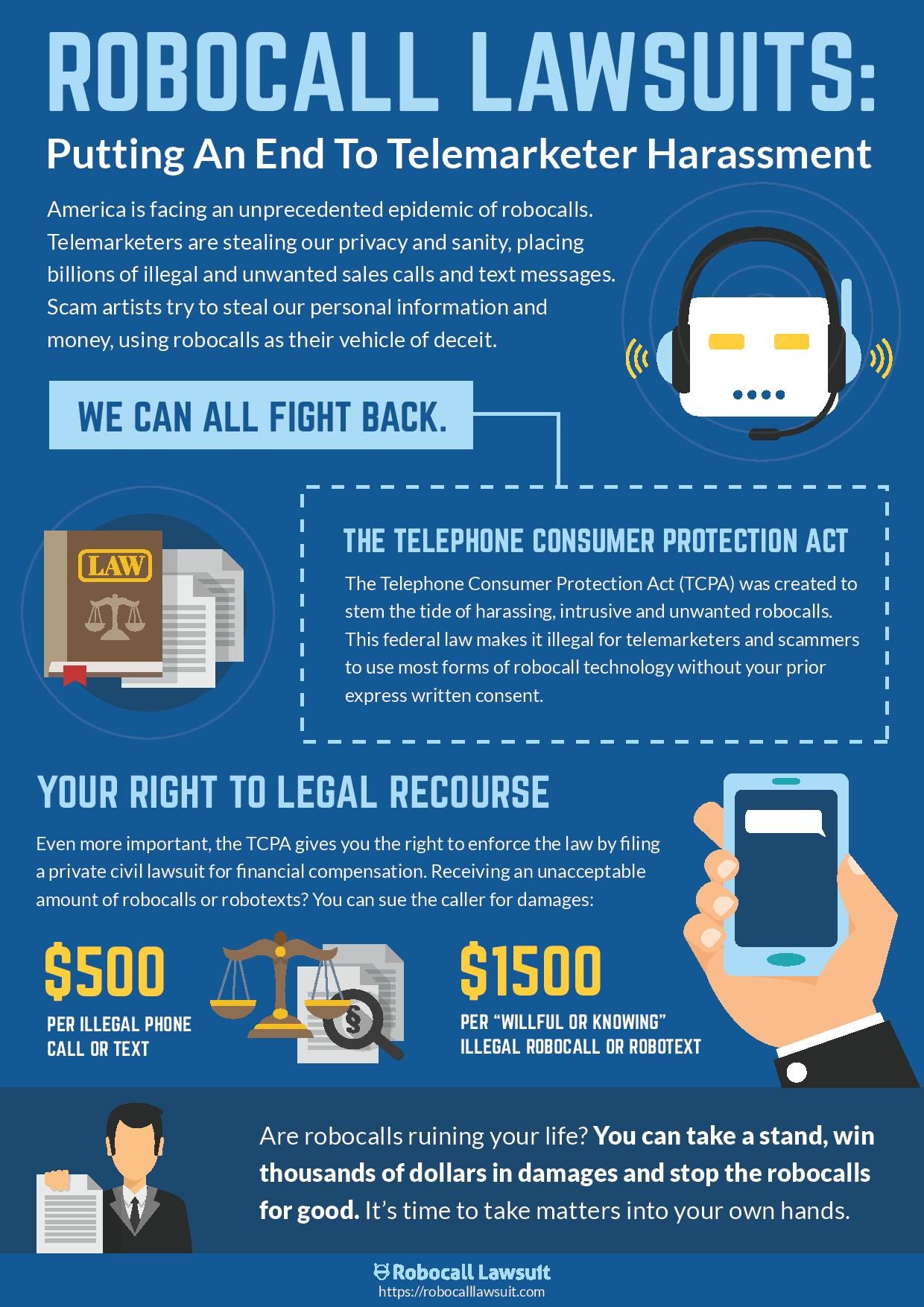
You can sue over illegal robocalls and spam texts. The Telephone Consumer Protection Act lets you recover $500 for each illegal call or text, and a court can raise that to as much as $1,500 per call if the company acted willfully or knowingly. To bring a case, you generally need the company’s name, a record of the calls, and no valid consent on file.
How TCPA Damages Work: Money for Every Illegal Call
The Telephone Consumer Protection Act is a federal law passed in the early 1990s. Unlike most consumer laws, it sets a dollar amount for each violation. You do not have to prove the calls cost you money, because the law sets the damages for you.
There are two main ways a call or text breaks the law, and each has its own damages rule.
| What happened | Where the rule is | What a court can award |
|---|---|---|
| A prerecorded or artificial voice call, or an autodialed call or text, to your cell phone without your consent | 47 U.S.C. 227(b)(1) and (b)(3) | $500 per violation, or your actual loss if higher |
| More than one telemarketing call in 12 months from the same company to a number on the National Do Not Call Registry | 47 U.S.C. 227(c)(5) | Up to $500 per violation |
| Either of the above, done willfully or knowingly | 227(b)(3) and 227(c)(5) | Up to three times the award, so up to $1,500 per violation |
Ten illegal prerecorded calls can add up to $5,000 before any increase for willfulness. That math is why companies that ignore the rules often settle.
One honest caveat: the TCPA does not make the company pay your lawyer. Unlike some other consumer protection laws, it has no fee-shifting provision. Lawyers who take these cases on contingency are paid from what you recover, so the case has to be worth enough to justify the work.
Deadlines apply to every claim, and each call can carry its own clock. Older calls may still count, but waiting can cost you claims, so reach out sooner rather than later.
How to Sue a Robocaller: 4 Steps to Build a TCPA Case
-
-
-
- Document the calls. Write down every call and text: the date, time, number on your screen, and what was said. Screenshot your call history and save voicemails. A notebook works, and so does our printable call log on the build-a-case page.
- Identify the company. A lawsuit needs a defendant. Robocallers often hide behind spoofed numbers, so the number alone rarely proves who called. If you choose to answer, listen to the pitch and ask for the company’s legal name, website, and a callback number.
- Get a case review. Send us what you have. We look at whether you consented, whether your number was on the Do Not Call Registry, whether a recorded or artificial voice was used, and whether you asked them to stop.
- File a demand or lawsuit. If the case is worth bringing, a demand letter or lawsuit follows. Both federal and state courts can hear TCPA cases. Our step-by-step guide to suing a telemarketer walks through each stage.
-
-
Do You Have a Robocall Lawsuit? How We Evaluate TCPA Claims
We would rather tell you now that you do not have a case than waste your time. Here is how we sort them.
Signs of a Strong Robocall Case
- Prerecorded or AI-voice sales calls to your cell phone from a company you never gave your number to.
- Repeated sales calls to a number that was already on the Do Not Call Registry for at least a month before the calls started.
- A debt collector or lender calling your cell with a recorded message for someone else, and still calling after you said it was the wrong number.
- Calls or texts that kept coming after you clearly told the company to stop, including by replying STOP.
- A company name you can prove: an email, a website they gave you, a branded text, or a voicemail naming them.
When Robocalls Are Usually Not a Lawsuit
- A single call. The Do Not Call rule requires more than one call from the same company within a year.
- Calls you agreed to. If you gave a business written consent and never took it back, the calls are usually allowed.
- Political, charity, and survey calls to a Registry number. The Registry does not cover these, though other TCPA rules may still apply.
- Live, hand-dialed calls to a number not on the Registry. These generally fall outside the robocall rules. The Supreme Court has also narrowed what counts as an “autodialer,” so many systems that dial from stored lists are no longer covered by that rule.
- Callers no one can identify. That is not the end of the road, but it means documenting until the caller slips and gives a name.
Common Illegal Robocalls and Spam Texts
Most of what people send us falls into a few patterns. Extended car warranty pitches, Medicare and health plan offers, solar and home improvement calls, “cardholder services” credit card rate calls, and loan offers are classic telemarketing. Debt collection calls to the wrong person are a separate and often strong category, covered on our page about wrong-number robocalls. Spam texts have their own rules, explained in our guide to illegal spam texts.
You can browse every call type, with the rule that applies to each, in the robocall violations library.
TCPA Class Action Settlements vs. Your Own Robocall Lawsuit
Some companies have already been sued in class actions. If you are a class member, you may be able to file a claim without hiring anyone. Class payouts are usually much smaller than an individual case, though. In some well-known robocall settlements, each claimant received well under $100, far less than the $500 per call an individual can seek.
You may already be in a class without knowing it. Our page on how TCPA class actions work explains when to file a claim and when your own case is worth more. If you have a number but no company name, our guide to identifying who is calling you shows how to find out.
About the Robocall Lawyer Behind This Site
RobocallLawsuit.com is published by Laurence Banville, Esq., Managing Partner of Banville Law in Tarrytown, New York. He is admitted to practice in New York and the District of Columbia.
He started his career on the other side. From 2009 to 2010, he was an associate at Wilbraham, Lawler & Buba, doing insurance-defense products liability work, defending corporations and insurers. That is useful here: TCPA defendants are companies with lawyers and insurers, and he knows how they build a defense. Read his full background and bar admissions.
Banville Law may refer your matter to, or work as co-counsel with, another law firm. You will be told before any referral and may choose other counsel.
Get a Free Robocall Case Review
If you can name the company and provide a rough count of the calls, send us your details for a free review. If you only have numbers and no name yet, start a call log today and ask the next caller who they work for. Either way, do not agree to anything on the phone and never give out payment details.
Robocall Lawsuit FAQs
Can you really sue for robocalls?
Yes. The TCPA gives individuals the right to sue in federal or state court. Each illegal call or text can be worth $500, and up to $1,500 if the court finds the company acted willfully or knowingly.
Do I need to know who is calling me to sue?
Yes, a lawsuit needs a named defendant. If you only have phone numbers, keep a log and try to get the company’s legal name, website, or email on the next call. A lawyer can sometimes trace a company through the numbers, but a name makes a case much stronger.
How much does a robocall lawyer cost?
Most TCPA lawyers work on contingency, meaning no attorney fee unless you recover. Because the TCPA does not require the company to pay your legal fees, the fee comes from the recovery. Ask in writing for the percentage and how case costs are handled before you sign.
Is one spam call enough for a lawsuit?
Usually not. The Do Not Call claim requires more than one telemarketing call within a year from the same company. A single prerecorded call to your cell without consent is technically a violation, but on its own it is rarely worth a lawsuit.
How long do I have to file a robocall lawsuit?
There are filing deadlines, and they can differ depending on the type of claim and whether state law also applies. Because each call may have its own deadline, older calls can sometimes still count. Talk to a lawyer promptly so you do not lose claims to the clock.
Sources
- 47 U.S.C. 227 (Telephone Consumer Protection Act), Cornell LII
- 47 C.F.R. 64.1200 (FCC telemarketing and robocall rules), Cornell LII
- 28 U.S.C. 1658 (four-year federal limitations period), Cornell LII
- Facebook, Inc. v. Duguid, 592 U.S. 395 (2021), Supreme Court opinion
- In re Capital One Telephone Consumer Protection Act Litigation, No. 12 C 10064 (N.D. Ill. Feb. 12, 2015), final approval opinion
- FTC: National Do Not Call Registry FAQs