The TCPA, or Telephone Consumer Protection Act of 1991 (47 U.S.C. 227), is the federal law that limits robocalls, autodialed texts, telemarketing and junk faxes. It requires consent for automated and prerecorded calls, protects numbers on the Do Not Call Registry, and lets you sue for $500 per violation, up to $1,500 if willful.
What the TCPA is
TCPA stands for the Telephone Consumer Protection Act. Congress passed it in 1991, when automated dialers and fax machines were new tools for selling. It is codified at 47 U.S.C. 227. The Federal Communications Commission writes the detailed rules, found at 47 CFR 64.1200.
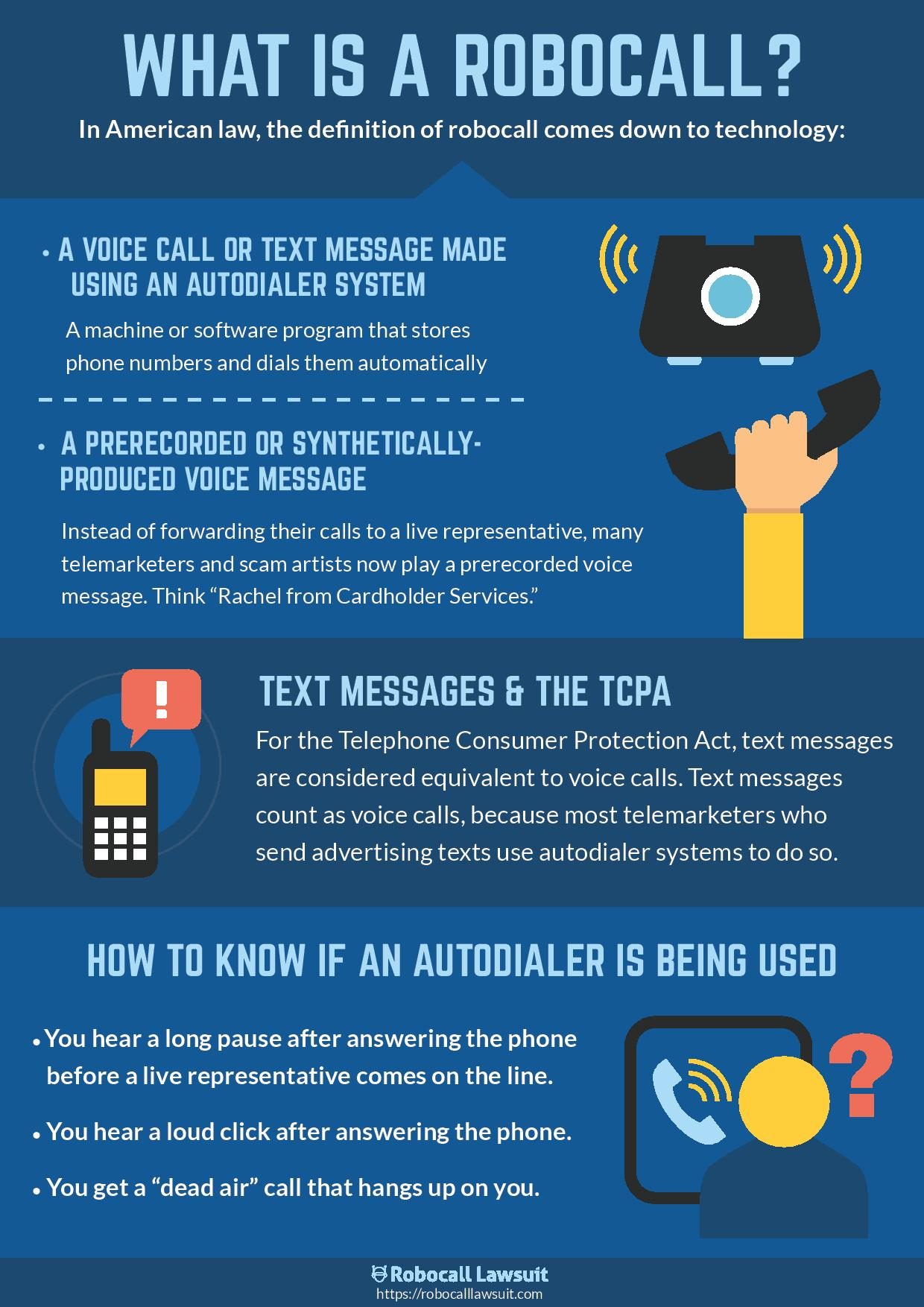
The law does three main things. It restricts calls made with autodialers and prerecorded or artificial voices. It created the legal basis for the National Do Not Call Registry and company do-not-call lists. And it bans unsolicited fax ads. What makes the TCPA unusual is that it lets ordinary people sue, and it sets the damages in advance so you do not have to prove the calls cost you money.
The TCPA in one table
| What the law covers | The basic rule | Guide |
|---|---|---|
| Robocalls to cell phones | Autodialed or prerecorded calls need prior express consent. Sales robocalls need written consent. | Consent rules |
| Recorded and AI voices | Any artificial or prerecorded voice call needs consent. AI and cloned voices count as artificial. | Prerecorded and AI calls |
| Autodialers | Only equipment that stores or produces numbers with a random or sequential number generator. | Autodialer definition |
| Do Not Call Registry | No sales calls to registered numbers after 31 days, with narrow exceptions. | Do Not Call law |
| Calling hours | Sales calls only between 8 a.m. and 9 p.m. your local time. | Calling hours |
| Text messages | Treated as calls for autodialer rules; Do Not Call claims over texts are contested. | Text message rules |
| Saying stop | Revoke consent any reasonable way; callers must stop within ten business days. | Revoking consent |
| Junk faxes | No fax ads without a business relationship, a proper number source, and an opt-out notice. | Junk fax law |
| The FCC rules | The regulation behind all of the above, with 2024 to 2026 changes. | FCC TCPA regulations |
| Money | $500 per violation, up to $1,500 if willful or knowing. | TCPA penalties |
| Deadline | Four years from each call or text. | Statute of limitations |
What the TCPA means for you
If a company robocalled your cell phone to sell you something without your written permission, texted you from an autodialer after you replied STOP, or kept calling a number that has been on the Do Not Call Registry for more than a month, the TCPA may give you a claim. Each call or text is counted separately. A dozen unlawful calls can mean a dozen violations.
The TCPA gives you two ways to sue. Section 227(b)(3) covers robocalls, prerecorded and artificial voice calls, autodialed texts and junk faxes. Section 227(c)(5) covers Do Not Call violations, but only if the same company called you more than once in 12 months. Neither requires you to prove financial harm.
What the TCPA does not do
It helps to know the limits before you spend time on a claim.
- It does not ban all unwanted calls. A live person calling by hand, not selling anything, is mostly outside the law.
- It does not cover most political or charity calls under the Do Not Call rules, since those are not sales calls. Robocalls to cell phones still need consent, even from campaigns. The Supreme Court upheld that ban in Barr v. American Association of Political Consultants (2020), striking only a carve-out for government debt collection.
- It does not help much against scammers you cannot identify. A lawsuit needs a defendant. Illegal callers may use spoofed numbers. Identifying the company behind the call is often the hardest step.
- It does not cover one-off mistakes very well. One Do Not Call violation, with no second call in 12 months, is not enough to sue under 227(c)(5).
How the law has changed recently
How courts and the FCC read the TCPA has shifted a great deal in the last five years:
- 2021: Facebook v. Duguid narrowed the definition of autodialer to equipment using a random or sequential number generator.
- February 2024: the FCC ruled that AI-generated and cloned voices are “artificial” voices under the TCPA.
- January 2025: the Eleventh Circuit vacated the FCC’s “one-to-one” consent rule.
- April 2025: new rules on revoking consent took effect, including the ten-business-day deadline and standard STOP words.
- June 2025: in McLaughlin Chiropractic v. McKesson, the Supreme Court held that district courts are not bound by the FCC’s reading of the statute.
- January 2026: the FCC delayed the “revoke all” part of the revocation rule to January 31, 2027.
- July 2026: the Seventh Circuit held that text messages are not “telephone calls” for Do Not Call lawsuits under 227(c)(5), a ruling binding in Illinois, Indiana and Wisconsin.
- September 2026: the FCC scheduled a September 30 vote on a draft order that would let callers designate an exclusive opt-out method and narrow the scope of a revocation for informational calls.
Each guide above reflects these changes as of September 23, 2026.
The TCPA and other laws
The TCPA overlaps with the FTC’s Telemarketing Sales Rule, which has its own Do Not Call and calling-hours rules but gives consumers a private lawsuit only when actual damages exceed $50,000. Debt collection calls are also governed by the Fair Debt Collection Practices Act. Many states have their own telemarketing laws, some stricter than federal law. Florida and Maryland, for example, stop sales calls at 8 p.m. rather than 9 p.m.
Where to start
Pick the guide that matches what is happening to you from the table above. Most people have three questions: whether their calls break the law, what a claim is worth, and whether they are still within the four-year deadline. Before anything else, start writing down every call and text: the date, time, number, what was said, and who was selling. Our evidence call log gives you a format. When you have a few entries, the case value calculator shows what the calls could be worth, and our guide on how to sue a telemarketer explains what happens next. That record is the foundation of every TCPA case, whether you end up in a class action, an individual claim, or neither.
Frequently asked questions
What does TCPA stand for?
The Telephone Consumer Protection Act, a 1991 federal law codified at 47 U.S.C. 227. The FCC’s implementing rules are at 47 CFR 64.1200.
What is a TCPA violation?
Common violations include autodialed or prerecorded calls to a cell phone without consent, telemarketing robocalls without written consent, two or more sales calls in 12 months to a number on the Do Not Call Registry, calls outside 8 a.m. to 9 p.m., continuing to call after you revoke consent, and junk faxes without an opt-out notice.
Can I sue under the TCPA?
Yes. The statute gives individuals a private right of action for $500 per violation, or up to $1,500 if willful or knowing. You need to be able to identify the company responsible, and you generally must file within four years of each call.
Does the TCPA apply to text messages?
The FCC treats texts as calls, and appeals courts have applied the autodialer rules to texts. Do Not Call claims over texts are now contested after a July 2026 Seventh Circuit ruling.
Sources
- 47 U.S.C. 227, Telephone Consumer Protection Act (Cornell LII)
- eCFR: 47 CFR 64.1200, Delivery restrictions (current through Sept. 21, 2026)
- Facebook, Inc. v. Duguid, 592 U.S. 395 (Apr. 1, 2021)
- Barr v. American Association of Political Consultants (U.S. July 6, 2020)
- McLaughlin Chiropractic Associates v. McKesson Corp., 606 U.S. 146 (June 20, 2025)
- FCC Declaratory Ruling FCC 24-17 (Feb. 8, 2024): AI-generated voices are artificial voices under the TCPA
- Insurance Marketing Coalition Ltd. v. FCC, No. 24-10277 (11th Cir. Jan. 24, 2025)
- FCC Order DA 26-12 (Jan. 6, 2026): revoke-all provision delayed to Jan. 31, 2027
- Steidinger v. Blackstone Medical Services, No. 25-2398 (7th Cir. July 14, 2026)
- FCC Fact Sheet and draft Report and Order (Sept. 9, 2026) for the Sept. 30, 2026 open meeting, CG Docket 02-278
- eCFR: 16 CFR 310.4, Telemarketing Sales Rule abusive practices
- 15 U.S.C. 6104, private actions under the Telemarketing Act (Cornell LII)
- Florida Statutes 501.616 (commercial telephone solicitation hours and frequency)
- Maryland Code, Commercial Law 14-4502 (Stop the Spam Calls Act restrictions)