To sue a telemarketer, confirm which TCPA rule the calls broke, identify the company behind them, and document every call. Then send a demand letter or file in small claims, state court, or federal court within four years of each call. Each violation can be worth $500, or up to $1,500 if willful.
Before you start: can this telemarketer be sued?
Three things have to be true for a telemarketing lawsuit to work. The calls must break a specific rule. You must be able to name who is responsible. And that company must be reachable by a court and able to pay. Most failed cases fail on the second or third point, not the first.
The law you will use is the Telephone Consumer Protection Act, 47 U.S.C. 227, and the FCC’s rules at 47 C.F.R. 64.1200. Some states add their own telemarketing statutes, which our state-by-state autodialer law guide covers.
Step 1: Match your calls to the rule they broke
A lawsuit does not say “they called too much.” It says which rule each call broke. Here are the ones that come up most with telemarketers:
| What happened | Rule | Damages |
|---|---|---|
| Recorded or AI voice sales message to your cell or home phone without your written consent | 47 U.S.C. 227(b)(1); 47 C.F.R. 64.1200(a) | $500 per call, up to $1,500 if willful |
| Two or more sales calls or texts in 12 months to a number on the National Do Not Call Registry | 47 U.S.C. 227(c)(5); 47 C.F.R. 64.1200(c)(2) | Up to $500 per call, up to $1,500 if willful |
| Sales calls continuing after you asked that company to stop | 47 C.F.R. 64.1200(d)(3) | Counted under 227(c)(5) |
| Sales calls before 8 a.m. or after 9 p.m. your time | 47 C.F.R. 64.1200(c)(1) | Counted under 227(c)(5) |
| Autodialed sales texts to your cell without consent | 47 U.S.C. 227(b)(1)(A) | $500 per text, up to $1,500 if willful |
Two details trip people up. First, the Do Not Call claim requires “more than one telephone call within any 12-month period by or on behalf of the same entity.” One call is not enough. Second, the autodialer claim got narrower in 2021. In Facebook v. Duguid, the Supreme Court held that an autodialer must have the capacity to use a random or sequential number generator. Many modern dialers call from stored lists, so the stronger claims today are usually prerecorded voice calls and Do Not Call violations. Our page on prerecorded and AI voice calls explains why those are often the cleanest cases.
Also check for consent. If you filled out a quote form, entered a sweepstakes, or checked a box online, the telemarketer may claim you agreed to calls. For recorded or autodialed sales calls, the FCC requires “prior express written consent”: a signed written agreement, which can be electronic, that clearly authorizes that seller to call you that way. Vague fine print often does not meet that standard, but you need to know what you signed.
Step 2: Identify who you are suing
The caller on the phone is often not the right defendant. Telemarketing usually runs through layers: a brand that sells the product, a lead generator, and a call center that dials. The TCPA reaches calls made “on behalf of” a company, which lets you sue the seller whose product was pitched, not just the call center.
Krakauer v. Dish Network shows how this works. Dish did not dial the calls. An outside retailer did. A jury found Dish responsible anyway, the court tripled the damages for willfulness, and in 2019 the Fourth Circuit upheld an aggregate award of $61,243,800 to a class of 18,066 people.
To identify the company:
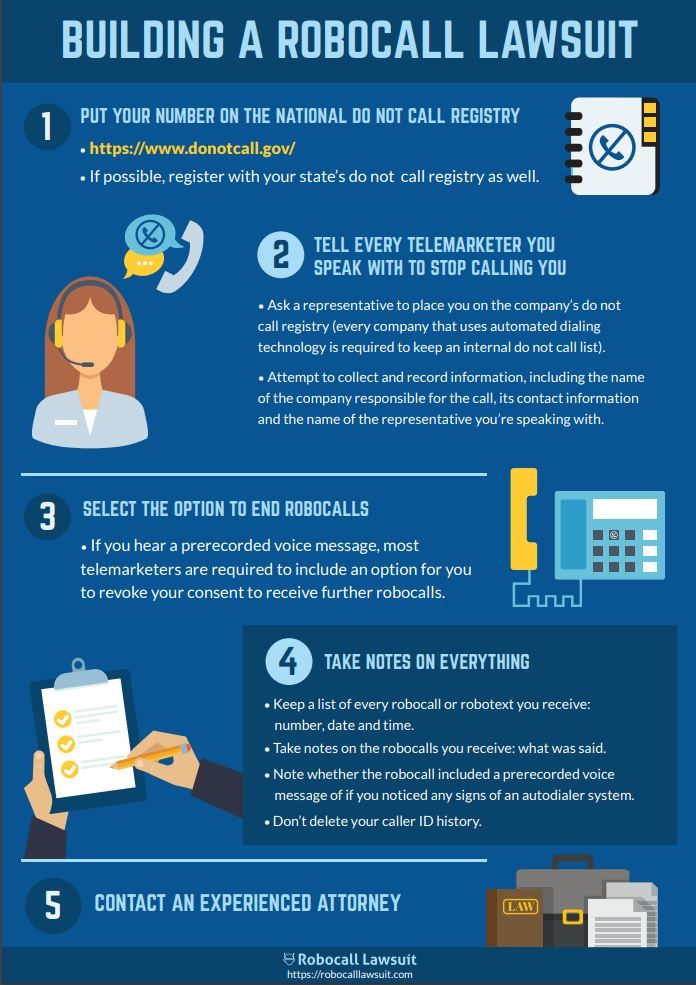
- Ask the caller for the company’s legal name, website, email, and a callback number.
- Note the product and brand being pitched. Brand names often lead to the real seller.
- Look up the company with your state’s secretary of state to get its exact legal name and registered agent.
- Save any email, text, or contract they send. These often name the seller outright.
If you cannot get a name yet, our guide to building a case when you can’t name the caller has scripts and a printable log.
Step 3: Gather evidence while it still exists
Evidence wins TCPA cases, and phones forget. Start now:
- A call log with date, time, number, and what was said for each call.
- Screenshots of your call history and text threads, showing numbers and timestamps.
- Saved voicemails, especially recorded sales messages.
- Proof of your Do Not Call registration date.
- Your phone carrier’s call records, which list every incoming call.
- Notes of when and how you told the company to stop.
Recording a call can be powerful but is regulated. Federal law allows it when one party consents, but some states require every party’s consent. Our robocall evidence guide lists the states and explains what else to save.
Step 4: Check your deadline
The TCPA itself does not set a filing deadline, so courts use the four-year federal catch-all in 28 U.S.C. 1658(a). Each call starts its own clock. Calls older than four years drop out one by one. State telemarketing laws can have different deadlines. See our explanation of the TCPA statute of limitations for how courts count it.
Step 5: Pick your path
You have four realistic options. They are not exclusive; many cases start with a letter and end in court.
Option A: Demand letter
A demand letter lays out the calls, the rules broken, and the amount you are asking for, and gives a deadline to respond. Send it to the company’s registered agent or legal department, not to the call center. Letters are cheap and sometimes work, especially against legitimate businesses that want the problem gone. They also warn the company, so have your evidence locked down first. A letter from a lawyer tends to be taken more seriously than one from an individual.
A useful demand letter includes: your name and phone number; the dates and times of each call; which calls were prerecorded, which came after your Do Not Call registration, and which came after you said stop; the statute sections involved; the amount you are asking for and how you got there; and a reasonable deadline to respond. Keep a copy and proof of delivery. Do not overstate the call count or threaten criminal charges. A clean, specific letter is more persuasive than an angry one.
Option B: Small claims court
The TCPA says a person may sue “in an appropriate court of that State” if the state’s laws and court rules allow it, and the Supreme Court confirmed in Mims v. Arrow Financial Services (2012) that state courts can hear these cases. Small claims courts are built for people without lawyers. Filing fees are low, procedures are simple, and hearings come fairly quickly.
The limits are real. Every state caps small claims awards, and caps vary widely, so check your court’s website. You still have to serve the company properly, often through its registered agent. And collecting a judgment from an out-of-state company can take more work than winning it.
Option C: State court (regular civil)
For claims above the small claims cap, a regular state civil court is an option. Procedures are more formal and look more like federal court. This path is less common for individuals without a lawyer.
Option D: Federal court
TCPA claims arise under federal law, so federal district courts can hear them. Filing costs a $350 fee set by 28 U.S.C. 1914(a), plus a $55 administrative fee from the Judicial Conference’s fee schedule. Federal court has strict rules on pleadings, service, discovery, and deadlines. Defendants there nearly always have lawyers. It is the right court for larger cases, willfulness claims, and class actions, and it gives you subpoena power to pull the company’s dialing records.
| Demand letter | Small claims | Federal court | |
|---|---|---|---|
| Cost to start | Postage | Low filing fee, varies by state | $405 total filing fees |
| Lawyer needed? | No, but helps | Designed for people without one | Strongly advised |
| Size of claim | Any | Capped by state law | No cap |
| Discovery of company records | None | Very limited | Full |
| Best for | Known, legitimate companies | A few well-documented calls | Many calls, willfulness, or class claims |
Step 6: File and serve
A complaint states who you are, who you are suing, each call or group of calls, which rule each broke, and what you are asking for: statutory damages, trebled damages for willful violations, and an order to stop. Then the company must be formally served, usually through its registered agent. Improper service is one of the most common reasons self-filed cases get dismissed.
Step 7: What happens after filing, and how long it takes
No one can promise a timeline. Here is the typical order of events:
- The company responds. It files an answer, a motion to dismiss, or reaches out to settle. Some default by not responding at all.
- Early settlement talks. Many individual cases settle here, once the company’s lawyer sees your evidence.
- Discovery. In federal court, each side exchanges documents. This is when call records, vendor contracts, and consent records come out.
- Motions. Either side may ask the judge to decide the case without a trial.
- Trial. Rare, but it happens. A jury can set per-call damages for Do Not Call claims, and the judge decides whether to increase the award for willful or knowing violations.
Small claims cases usually move much faster than federal ones. A federal case that does not settle early can run for many months, and longer if it goes to trial or appeal.
What telemarketing cases settle for
Individual settlements are usually confidential, so the honest public data comes from class actions and trials. It shows how wide the range is:
| Case | What the public record shows |
|---|---|
| Krakauer v. Dish Network (4th Cir. 2019) | Jury awarded $400 per Do Not Call violation; the court tripled it for willfulness. Aggregate judgment of $61,243,800 for 18,066 class members. |
| In re Capital One TCPA Litigation (N.D. Ill. 2015) | $75,455,099 fund. Only 1,378,534 people, 7.87% of the estimated class, filed claims. Recovery of at least $34.60 per claimant. |
| Bumpus v. Realogy Holdings Corp. (lawsuit alleged Do Not Call and prerecorded calls by Coldwell Banker affiliated agents; Realogy denied wrongdoing) | $20 million settlement. The administrator estimated about $281 per approved claim if 15% of the class claimed; payments went out June 16, 2026. |
| Geaslin v. Colony Ridge Development (lawsuit alleged marketing texts to Do Not Call numbers; the company denied the allegations) | $1,994,123 fund. The notice estimated $1,000 to $2,000 per participating class member; checks have been issued. |
The pattern: the fewer people who share a fund, the more each gets. An individual case with good evidence is measured against the full $500 to $1,500 per call, though settlements usually come in below the maximum to avoid the risk and cost of trial. Our calculator for TCPA damages shows the math on your own call count.
Mistakes that sink telemarketing lawsuits
- Suing the wrong entity. A brand name, a call center nickname, or a spoofed number is not a legal defendant. Use the company’s exact legal name.
- Accidentally consenting. Saying yes to a pitch, giving your number on a form to “get more info,” or pressing a key to opt in can hand the company a consent defense.
- Inflating the call count. Every call you claim must be backed by records. One invented call can damage your credibility for all the real ones.
- Recording illegally. In all-party consent states, secretly recording a call can expose you to liability of your own.
- Missing the deadline. Calls older than four years are usually gone.
- Serving the complaint wrong. Mail to a call center is not service.
- Taking a class settlement without thinking. Filing a class claim, or doing nothing, releases your claim for those calls. If you have a strong individual case, opting out may be worth more.
- Threatening to sue on the phone. It tends to make callers disappear or switch numbers before you have their name.
When a lawyer makes sense
You can sue a telemarketer without a lawyer, especially in small claims. A lawyer adds the most when there are many calls, when the company hides behind layers of vendors, when you want to prove willfulness, or when the defendant is a large company with its own counsel. Most TCPA lawyers work on contingency. Because the TCPA does not make the company pay your legal fees, the fee comes from the recovery. For the tradeoffs, see whether you need a lawyer to sue a robocaller.
Your next move
If you already know the company and have a record of calls, you are at Step 5. Send your details for a free review and we will tell you which path fits. If you have calls but no name, go back to Step 2 and get it on the next call. If you have one or two calls from a company that has now stopped, you may not have a case worth filing, and we will say so.
Frequently asked questions
Can you sue telemarketers for calling you?
Yes, if the calls broke a TCPA rule, such as prerecorded sales calls without written consent or repeated sales calls to a number on the Do Not Call Registry. Each violation can be worth $500, and up to $1,500 if willful.
How do I sue spam callers who hide their number?
You need to identify the company behind the calls, not just the number, because caller IDs are often spoofed. Ask the caller for the company’s legal name, website, and callback number, and save any texts or emails they send.
Can I sue a telemarketer in small claims court?
Yes, in most states. The TCPA allows suits in state courts where state rules permit, and the Supreme Court has confirmed state courts can hear TCPA cases. Check your state’s small claims dollar limit and service rules.
How much can I get for suing a telemarketer?
The TCPA sets $500 per violation, and up to $1,500 if the court finds the violation willful or knowing. Actual settlements vary with the evidence, the number of calls, and the company’s ability to pay.
Do I have to warn the telemarketer before suing?
The TCPA does not require a demand letter before filing. Some people send one to try to settle first, but it also alerts the company, so secure your evidence before you send it.
Sources
- 47 U.S.C. 227 (Telephone Consumer Protection Act), Cornell LII
- 47 C.F.R. 64.1200 (FCC telemarketing and robocall rules), Cornell LII
- Facebook, Inc. v. Duguid, 592 U.S. 395 (2021), Supreme Court opinion
- Mims v. Arrow Financial Services, LLC, 565 U.S. 368 (2012), Cornell LII
- Krakauer v. Dish Network, L.L.C., No. 18-1518 (4th Cir. May 30, 2019)
- In re Capital One Telephone Consumer Protection Act Litigation, No. 12 C 10064 (N.D. Ill. Feb. 12, 2015), final approval opinion
- Bumpus v. Realogy Holdings Corp., No. 3:19-cv-03309-JD, settlement website (Epiq)
- Geaslin v. Colony Ridge Development, LLC, No. 4:24-cv-02418 (S.D. Tex.), settlement website
- 28 U.S.C. 1658 (four-year federal limitations period), Cornell LII
- 28 U.S.C. 1914 (federal district court filing fee), Cornell LII
- U.S. Courts: District Court Miscellaneous Fee Schedule
- Justia: Recording Phone Calls and Conversations, 50-State Survey